ACADEMY MEMBER BENEFIT As a member of the Academy, this is your weekly update on current funding streams and trainings available through the National Institutes of Health (NIH). This information is aggregated weekly by Academy staff. |
Funding Announcements
April 30, 2024 |
|
|
Open NIH Funding Opportunities & Notices |
|
|
National Institute for Biomedical Imaging & Bioengineering (NIBIB) |
|
|
Advanced Research Project Agency (ARPA-H) |
|
|
ARPA-H Launches Two Programs to Shed Light on Invisible Health Challenges ARPA-H’s two newest programs shed light on two significant yet vastly different health challenges that significantly impact our health and are hard to see: lymphatic health and indoor air quality.
Making the lymphatic system visible. The lymphatic system is vital for human health yet invisible to the naked eye. The LIGHT (Lymphatic Imaging, Genomics, and Phenotyping Technologies) program, led by Program Manager Kimberly Steele, aims to develop comprehensive diagnostic solutions to better assess this critical bodily system.
Why it matters. Millions of?Americans with lymphatic dysfunction, including over 10 million with lymphedema, are misdiagnosed or undiagnosed?due to lack of diagnostic tools to assess the lymphatic system’s structure and function.? This leads to inappropriate treatments, prolonged hospital stays, absence from school and work, disfigurement, disability, and even death.
“The lymphatic system is underappreciated, and its critical role in our health has been overlooked for far too long,” said LIGHT Program Manager Kimberley Steele, M.D., Ph.D.. “It takes care of waste removal, maintains our body’s fluid balance, transports fat and protein, and supports our immune system. It plays a critical role in the spread of cancer and is also an important factor in many chronic diseases, including heart disease. We are decades behind in developing diagnostic tools to assess the health of the lymphatic system. This program will change that.”
Ensuring indoor air is always safe and healthy. Americans spend 90% of their lives indoors, yet we do more to monitor and reduce the health threats from the air we breathe outside than inside. The BREATHE (Building Resilient Environments for Air and Total Health) program, led by Program Manager Jessica Green, aims to drive the next generation of smart buildings to ensure indoor air is always safe and healthy.
Why it matters. Poor indoor air quality is a leading cause of preventable diseases like the flu and other respiratory illnesses. Airborne disease-causing pathogens and allergens can have a significant effect on people’s health, especially children, the elderly, and those living with chronic illnesses or are otherwise susceptible.
“As we experienced through the pandemic, having the ability to monitor, track, and improve the air we breathe indoors is urgently needed,” said BREATHE Program Manager Jessica Green. “BREATHE aims to revolutionize public health by transforming our ability to eliminate indoor air threats.”
To learn more about both programs, including how to register for the upcoming Proposers’ Days, visit the BREATHE program page and LIGHT program page.
ARPA-H’s Biohybrid Devices Summit now accepting requests for invitation
ARPA-H is hosting a Biohybrid Therapeutic Devices Summit in New Orleans, May 16-17, to bring together key funders, stakeholders, scientists, regulatory authorities, patient engagement groups, and the private sector to advance this field.
Biohybrid devices merge advances in synthetic biology, bioelectronics, and materials science to treat conditions from diabetes to obesity to cancer. Summit topics will address unmet needs, manufacturing, regulatory strategies, ELSI (Ethic, Legal, and Social Implications), and commercialization requirements of the field.
To request an invitation to the summit, visit the event’s registration webpage.
|
ARPA-H Joins DARPA on AI Cyber Challenge
Recent ransomware attacks on health care entities highlight how vulnerable our nation’s digital health infrastructure is to cyberattacks. These attacks profoundly impact patients’ access to care and treatments.
ARPA-H enters the AI Cyber Challenge arena. To find new solutions to address critical vulnerabilities in our nation’s hospitals, pharmacies, and medical devices, ARPA-H is joining forces with DARPA to expand the Artificial Intelligence Cyber Challenge (AIxCC).
Read more here. |
New ADAPT program poised to transform outcomes for Americans facing cancer |
ARPA-H announced the ADAPT (ADvanced Analysis for Precision cancer Therapy) program, a visionary collaboration between scientists, clinicians, and patients to usher in a new era of cancer care by harnessing advanced technologies to provide a deeper understanding of and treatment response to tumor biology.
“Changes in a tumor’s DNA, RNA, and proteins can drive treatment resistance,” said ADAPT Program Manager Andrea Bild, Ph.D. “ADAPT aims to employ advanced biomarker discovery techniques to detect these changes and identify the best next therapy as tumors evolve. Through ADAPT, we aim to improve patient response to therapy and increase survival time.”
Learn more by visiting the ADAPT program page, including information about the Special Notice, view the Proposers’ Day video, and how to state interest in forming an applicant team. |
Biden-Harris Administration's ARPA-H commits $100 million to accelerate women’s health research
First Lady Jill Biden announces funding as first major deliverable from new White House Initiative on Women’s Health Research
As the first major deliverable of the White House Initiative on Women’s Health Research, the Advanced Research Projects Agency for Health (ARPA-H), an agency within the U.S. Department of Health and Human Services (HHS), today announced the ARPA-H Sprint for Women’s Health, which commits $100 million towards transformative research and development in women’s health. ARPA-H, which was created in 2022 as part of President Biden’s bipartisan Unity Agenda, seeks to advance and accelerate health solutions...
Read more here. |
|
|
National Cancer Institute (NCI) |
|
|
NCI Special Initiatives
Funding Announcements and Notices for COVID-19
NCI is providing funding for research on COVID-19 and revising certain existing grants and cooperative agreements to make funds available to help address the public health crisis. New funding notices will be added to this page as they become available.
Cancer Moonshot? Funding Opportunities
NCI is accepting applications for research grants that support the Cancer Moonshot Blue Ribbon Panel recommendations to speed progress in cancer research and lead to improved cancer prevention, detection, and treatment.
MERIT Award
Early Stage Investigators who have submitted an R01 application within the NCI payline may be eligible for consideration for the Method to Extend Research in Time (MERIT) (R37) Award.
Outstanding Investigator Award
The Outstanding Investigator Award gives investigators the freedom to work on long-term projects with unusual potential in cancer research.
Provocative Questions Program
Provocative Questions is an NCI initiative that intends to assemble a list of important questions, or problems that are paradoxes in cancer research that will stimulate research communities to use laboratory, clinical, and population sciences in new, effective, and imaginative ways.
RAS Initiative
The RAS Initiative enlists collaborators from all sectors of the research community to work together to attack mutant RAS-driven cancers. Research Specialist Award (R50)
The R50 encourages the development of stable research career opportunities for exceptional scientists who want to continue to pursue research within the context of an existing NCI-funded basic, translational, clinical or population science cancer research program, but not serve as independent investigators.
NCI Funding Opportunities by Research Topic Imaging/Radiology
Research related to imaging and imaging technology development, in addition to other associated topics.
Basic Biology
Research projects in basic cancer biology are supported and coordinated through the Division of Cancer Biology (DCB). Behavioral Research
Behavioral research in cancer prevention and control is supported by the Division of Cancer Control and Population Sciences (DCCPS). Biorepositories and Tissue Sample Collection
Development of biospecimen-related policies and practices affecting NCI Biorepositories is coordinated and managed through the Biorepositories and Biospecimen Research Branch (BBRB).
Complementary and Alternative Medicine
Research contributing to the advancement of evidence-based complementary and alternative medicine practice is supported by the Office of Cancer Complementary and Alternative Medicine (OCCAM). Cancer Health Disparities
Basic cancer research from a health disparities perspective is supported by the Center to Reduce Cancer Health Disparities (CRCHD).
Epidemiology and Cancer Control
Research in genetic, epidemiologic, behavioral, social, and surveillance cancer research is supported by the Division of Cancer Control and Population Sciences (DCCPS). HIV /AIDS and Cancer
Research on HIV/AIDS pursued throughout the NCI, including programs in AIDS-related cancer are coordinated by the Office of HIV and AIDS Malignancy (OHAM).
Nanotechnology
Research supporting the application of nanotechnology to all aspects of cancer research is supported by the NCI Alliance for Nanotechnology in Cancer program that is managed by the Office of Cancer Nanotechnology Research (OCNR). Physical Sciences-Oncology
Research supporting the establishment of scientific teams and individual scientists from the fields of physics, mathematics, chemistry, and engineering to develop novel approaches for cancer research is managed by the Physical Sciences in Oncology Initiative.
Prevention
Research that determines and reduces a person's risk of developing cancer, as well as research to develop and evaluate cancer screening procedures, is supported by the Division of Cancer Prevention (DCP).
Proteomics
Research supporting the development of technologies and reagents that will advance our understanding of protein biology in cancer is supported by the Office of Cancer Clinical Proteomics Research (OCCPR). Small Business and Small Business Technology Transfer
Opportunities to increase small business and private sector participation to develop and commercialize novel technologies to prevent, diagnose, and treat cancer are managed by the Small Business Innovation Research and Small Business Technology Transfer (SBIR and STTR) programs.
Statistical Methodology
Resources for statisticians are available from StatFund, an online resource that provides information about biostatistical funding opportunities. Technology Development
Research supporting the development of technologies in clinical, laboratory, and epidemiological research are managed by the Innovative Molecular Analysis Technologies Program (IMAT). Translational Research
Research supporting the translation of promising research areas into improved diagnostic and therapeutic interventions for cancer patients is supported by the Division of Cancer Treatment and Diagnosis (DCTD). |
|
|
National Institute on Aging (NIA) |
|
|
National Institute on Mental Health (NIMH) |
| |
National Institute on Drug Abuse (NIDA) |
|
|
National Heart, Lung, and Blood Institute (NHLBI) |
|
|
National Institute of Neurological Disorders and Stroke (NINDS) |
|
|
National Institute of Allergies and Infectious Disease (NIAID) |
|
|
National Institute of Arthritis and Musculoskeletal and Skin Diseases (NIAMS)
|
|
|
Climate Change & Sustainability Resources |
|
|
Online Funding Resources: |
|
|
Highlighted Announcements
|
|
|
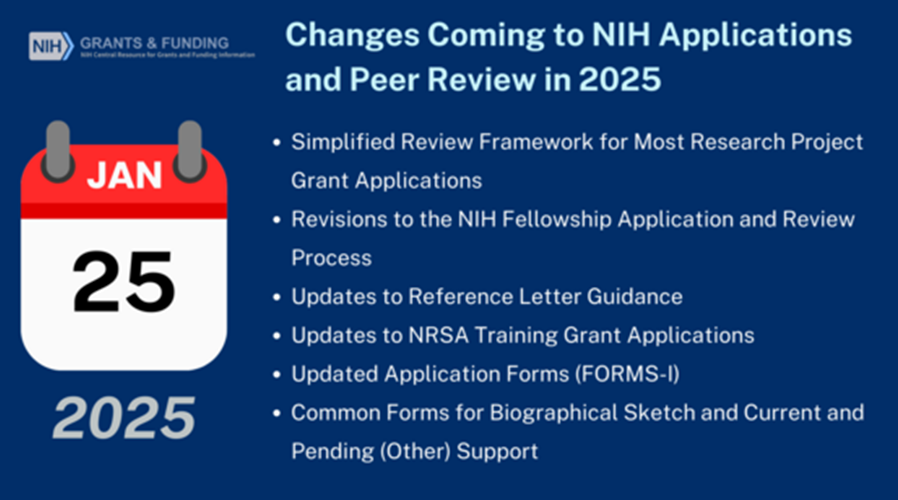
Changes Coming to NIH Applications and Peer Review in January 2025 |
|
|
National Academies releases proceedings from October 2023 workshop on emerging technologies and innovation in manufacturing regenerative medicine therapies
In October 2023, the National Academies Forum on Regenerative Medicine hosted a public workshop on "Emerging Technologies and Innovation in Manufacturing Regenerative Medicine Therapies." Speakers explored emerging technologies, evolving manufacturing approaches, regulatory considerations, and diverse partnerships needed to increase regenerative medicine treatment capacity. While manufacturing advances have accompanied some of this expansion, the field of regenerative medicine has started to anticipate the potential of strategies such as artificial intelligence, decentralized manufacturing, and automation to increase the availability and reduce the cost of regenerative medicine therapies. Read this Proceedings of a Workshop—in Brief for highlights of the presentations and discussions that occurred at this workshop.
For more information, please visit the project webpage. |
New commentary champions All of Us Research Program dataset
NIBIB Director Dr. Bruce Tromberg joined other NIH Institute and Center directors in a joint commentary published recently by Nature Medicine. They highlight the diversity of the All of Us Research Program participant cohort and urge researchers to use the program’s dataset in their studies. This invaluable resource enables research across many areas of importance to NIH and may accelerate medical discoveries that benefit us all in the future. Read the full commentary from Nature Medicine.
|
|
|
Analysis of social media language using AI models predicts depression severity for white Americans, but not Black Americans
Researchers were able to predict depression severity for white people, but not for Black people using standard language-based computer models to analyze Facebook posts. Words and phrases associated with depression, such as first-person pronouns and negative emotion words, were around three times more predictive of depression severity for white people than for Black people. The study, published today in the Proceedings of the National Academy of Sciences, is co-authored by researchers at the University of Pennsylvania, Philadelphia, and the National Institute on Drug Abuse (NIDA), part of the National Institutes of Health (NIH), which also funded the study.
Read the press release here. |
|
|
Moving beyond individual-level determinants of mental health to address mental health disparities The National Institute of Mental Health (NIMH) has issued a request for information (RFI) that invites input on addressing gaps in: Identifying determinants of mental health disparities beyond the individual level (for example, at the social, systemic, and structural levels)
Developing culturally responsive, multilevel interventions to address mental health disparities
NIMH is interested in hearing from healthcare providers, scientific research communities, patient advocacy groups, people with lived experience, educators, and other interested parties about these gaps in U.S.-based research. How to submit responses
All responses must be submitted electronically on the RFI submission website. NIMH encourages organizations (for example, patient advocacy groups, professional organizations) to submit a single response that reflects the views of the organization and membership as a whole. Responses must be received by May 30, 2024, at 11:59 p.m. ET. |
|
|
Tap into trusted NIA resources to transform your research
It’s exciting to hear about research breakthroughs aimed at improving human health. These discoveries often begin with meticulously designed and conducted basic science that requires trusted and reliable biological resources.
Learn how NIA’s high-quality resources like cell cultures and tissue samples can save your lab time and money. Read the full blog post.
|
|
|
NIAMS Update NIAMS has announced some changes to its funding policies.
Dr. Lindsey Criswell, Director of NIAMS, recently released a Director’s letter discussing these changes and how they will allow the institute to better address gaps and opportunities in its broad portfolio mission areas. Read the Director’s Letter for more information and refer to the NIAMS Funding Policies?and Fiscal Year 2024 Funding Plan?as well.
|
|
|
NIH Science Education Partnership Award (SEPA) Program
NIBIB has signed on to the latest funding opportunity PAR-23-137 of the NIH SEPA R25 program, which supports science educational activities for pre-kindergarten to grade 12 (P-12) students and teachers in all communities and regions of the country, to encourage them to pursue further studies in science, technology, engineering, and mathematics (STEM). SEPA funds activities centered on any discipline of health research within NIH’s mission, including classroom-based projects for P-12 students and teachers and informal science education projects conducted in outside-the-classroom venues such as science centers, museums and libraries. More details are provided here.
Applications are due June 7, 2024. Those interested in applying for a SEPA R25 grant are strongly encouraged to attend our informational webinar that will be held on April 4, 2024, from 3:00 – 4:30 PM EST. Full details of this event, including a link to the Zoom, can be found here. Participants requiring sign language interpretation and/or other reasonable accommodations should submit a request using our contact form at least five days prior to the event.
To learn more about the SEPA program, please contact NIBIB's contact, Dr. Tina Gatlin, at gatlincl@nih.gov.
|
|
|
NIA is leading efforts to coordinate NIH palliative care research
|
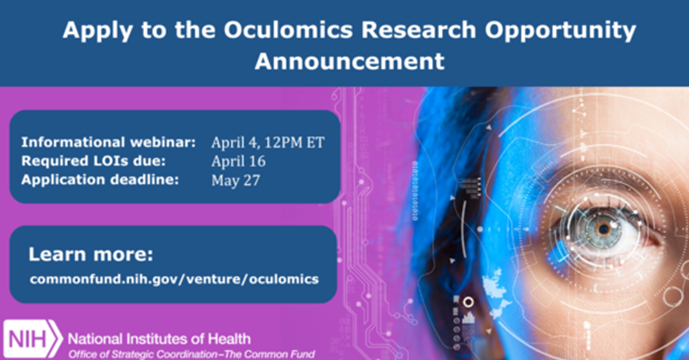
The NIH Common Fund is happy to announce that the new NIH Common Fund Venture Program Oculomics initiative is underway!
The Common Fund Venture Program is a new area of Common Fund support that provides a framework for development of short-term Common Fund initiatives that embrace scientific risk and are responsive to the shared priorities of NIH Institutes, Centers, and the Office of the Director (ICOs).
The Common Fund Development and Application of Imaging Technologies for Oculomics (Oculomics) Venture Initiative aims to support novel, noninvasive ocular (eye) imaging technologies, machine learning algorithms, and other tools to identify highly sensitive and specific biomarkers for diseases that affect the entire body.
The Oculomics initiative released a Research Opportunity Announcement to invite applications for development, application, and initial translation of new imaging technologies and machine learning algorithms for the detection and identification of novel systemic disease biomarkers. Award applicants are strongly encouraged to form multidisciplinary teams that consist of academic/industry experts relevant to the research plan.
Join the informational webinar on April 4, 2024 at 12PM ET
Register now!: https://bit.ly/OculomicsROA_Webinar
Letters of Intent (LOI) are Required, due: April 16, 2024 Applications are due: May 27, 2024, by 5:00 PM local time of applicant organization |
|
|
NIH Common Fund Venture Program Oculomics Initiative Research Opportunity Announcement |
We are happy to announce that the new NIH Common Fund Venture Program Oculomics initiative is underway!
The Common Fund Venture Program is a new area of Common Fund support that provides a framework for development of short-term Common Fund initiatives that embrace scientific risk and are responsive to the shared priorities of NIH Institutes, Centers, and the Office of the Director (ICOs).
The Common Fund Development and Application of Imaging Technologies for Oculomics (Oculomics) Venture Initiative aims to support novel, noninvasive ocular (eye) imaging technologies, machine learning algorithms, and other tools to identify highly sensitive and specific biomarkers for diseases that affect the entire body.
The Oculomics initiative released a Research Opportunity Announcement to invite applications for development, application, and initial translation of new imaging technologies and machine learning algorithms for the detection and identification of novel systemic disease biomarkers. Award applicants are strongly encouraged to form multidisciplinary teams that consist of academic/industry experts relevant to the research plan.
Join the informational webinar on April 4, 2024 at 12PM ET
Register now!: https://bit.ly/OculomicsROA_Webinar
Letters of Intent (LOI) are Required, due: April 16, 2024 Applications are due: May 27, 2024, by 5:00 PM local time of applicant organization |
|
|
Notice of Special Interest: Administrative Supplements for Research on Women’s Health in the IDeA States
The Office of Research on Women's Health (ORWH) and the National Institute of General Medical Sciences (NIGMS), along with the other participating NIH Institutes, Centers, and Offices, announce the availability of administrative supplements to Institutional Development Award (IDeA) awards to expand research and research capacity in the IDeA states to address important issues of women’s health across the lifespan. The proposed research must be within the scope of the parent grant and must address at least one of the strategic goals of the 2019-2023 Trans-NIH Strategic Plan for Women's Health Research "Advancing Science for the Health of Women."
The IDeA program is congressionally mandated and administered by NIGMS. It supports research and research capacity building in states that historically have had low levels of NIH funding through a variety of funding mechanisms. The IDeA program has been instrumental in increasing the pool of early-stage investigators from IDeA states who apply for NIH research project grants and in strengthening research infrastructure in those states. This NOSI encourages a broad range of research addressing important issues of women’s health across the lifespan, with a special interest in maternal and infant morbidity and mortality, including their underlying causes.
NIBIB interests include the development and integration of advanced bioengineering, sensing, imaging, and computational technologies for the improvement of human health and medical care. An application is not within the NIBIB mission if its principal focus is the development of a technology with the goal of understanding basic biological function or pathological mechanisms. Additionally, NIBIB only supports projects developing platform technologies that are applicable to a broad spectrum of disorders and diseases. However, applicants may propose research that utilizes only a single tissue, organ, or physiological condition as a model system to facilitate the development of what is expected to be a more broadly applicable enabling technology. Potential applicants are encouraged to contact the appropriate program director in their scientific program area of interest to determine if their research fits within the NIBIB mission.
Applications are due by October 18, 2024. More information can be found here. |
|
|
Upcoming Events and Meetings
|
|
|
Facebook Live: Brain Stimulation Therapies |
|
|
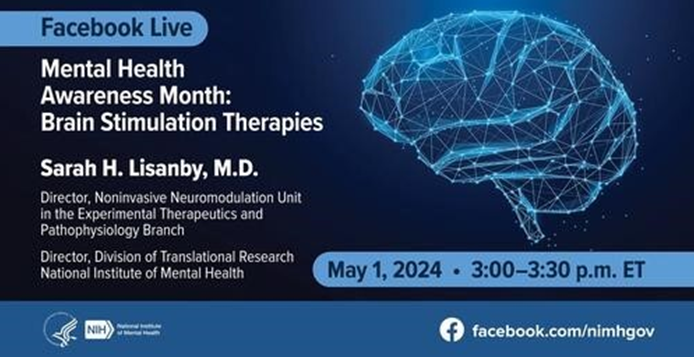
Date/Time: May 1, 2024 from 3:00-3:30 p.m. ET In recognition of National Mental Health Awareness Month, we're hosting a Facebook Live event on brain stimulation therapies featuring NIMH expert Dr. Sarah H. Lisanby. Brain stimulation therapies can help people with certain mental disorders who have not responded to other treatments. During the event, Dr. Lisanby will describe common types of brain stimulation therapies, why they are used, dispel misconceptions, and highlight NIMH-supported research in this area.
|
|
|
2024 BRAIN Initiative Conference Registration Now Open! |
|
|
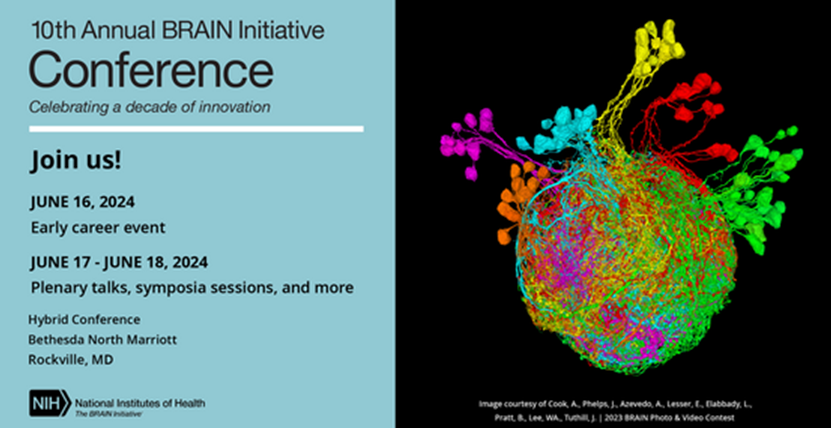
The Brain Research Through Advancing Innovative Neurotechnologies® Initiative, or The BRAIN Initiative®, is celebrating a decade of innovation! Registration is now open for the hybrid 10th Annual BRAIN Initiative Conference in Rockville, MD. Early career researchers are invited to attend “BRAIN, Neuroscience, and Beyond: Building Our Early Career Community” on Sunday, June 16, 2024. Two days of plenaries, symposia sessions, scholar spotlights, posters, and networking will follow on Monday, June 17 and Tuesday, June 18, 2024. This will be a hybrid conference, with the in-person portion taking place at Bethesda North Marriott in Rockville.
You can register for the conference here.
|
|
|
No opportunities today, please check back next week! |
|
|
For questions on any of the above, or suggestions on what you would like to see here each week, please contact Josie Wilkinson, jwilkinson@acadrad.org. |
|
|
|